• About
  • In the Media
  • Publications
  • Radio
  • Speaking

dinabrawer

~ from Rebbetzen to Maharat

dinabrawer

Tag Archives: ritual

Editing Ourselves Into the Haggadah

31 Tuesday Mar 2026

Posted by dinabrawer in Jewish Festival, Important Moments

≈ Leave a comment

Tags

Orthodox Judaism, religion, ritual, faith, Passover, god, bible

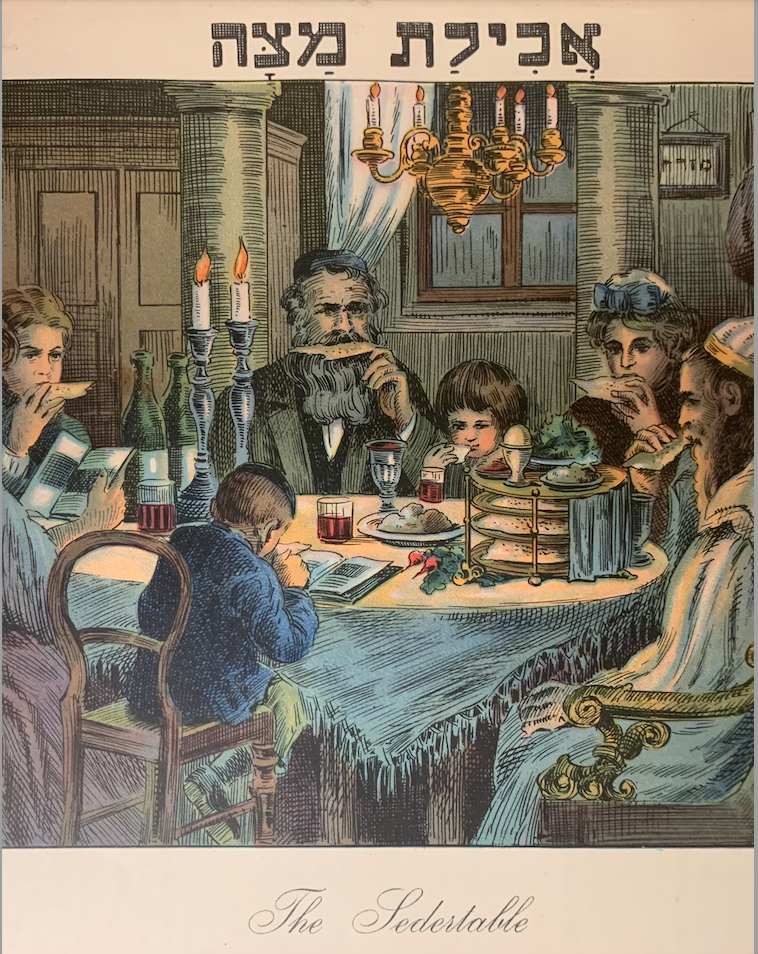
It’s almost Seder night. After much preparation, we’re going to finally recline, as instructed, and retell a story that, well… we already know! 

The Haggadah, the story of the Israelites’ slavery and redemption from Egypt, reads nothing like a history. There’s no single narrator, no hero, no tidy chronology. It’s fragmented, digressive, full of odd rabbinic anecdotes. And yet we read the whole thing, every year, even though we know how it ends.

The text itself appears self-aware of this. Right at the start, it tells us: even if you are wise, even if you already know the story, you are still obligated to retell it tonight. And the most radical thing about the Haggadah is how it insists we put ourselves at the center of the telling. 

We don’t say God redeemed our forefathers. We say God did this for me. First person. As if we were there. We sing Dayenu as if each miracle was performed on our behalf, personally. The Exodus, told in this way, is not past tense but perpetually present, annually retrieved and reconsolidated into our own lives.

This turns out to be exactly how memory works.

The philosopher Mark Rowlands writes about a memory he has of his father, an episode that occurred in his childhood that he can picture vividly, except that in his mind’s image, his father appears as an older man, not the 35-year-old he would have actually been at the time of the event. The reason, Rowlands argues, is that the memory was not really authored by him at all. Mark would have been too young to form the memory himself. But his father, dramatically retelling the story countless times, imbued this memory in him. Mark now owns the memory, it lives in his brain, but his father authored it. 

Rowlands calls this the division between ownership and authorship. We assume memory is a private, faithful recording of what we experienced. But memory is soft and labile. Each time we retrieve it, it returns to a malleable form, open to being recast. The person who speaks it aloud, who keeps returning to the episode, narrating and shaping it, becomes its author. The listener, who receives the story again and again, finds his own memory reconsolidating around the teller’s version. 

The Haggadah knows this. It ritualizes it. 

Each year, the memory of the Exodus is retrieved in its soft, labile state and reshaped through the Haggadah’s narrative contours: we listen to the rabbis debating through the night in B’nei Brak; we point to ‘Pesach, Matza, Maror’ and their symbolic meaning. As we ask our questions and speak our interpretations aloud, we become both authors and owners.  

At the Seder we don’t commemorate the Exodus, we edit ourselves into the collective Jewish memory. 
Pesach Sheni: How Access and Experience Shape Us

25 Sunday Apr 2021

Posted by dinabrawer in Jewish Festival

≈ Leave a comment

Tags

access, belonging, exclusion, inclusion, Passover, Pesach, ritual

Our Pesach Seder is largely focused on the Haggadah. In the time of the Beit HaMikdash however, the key ritual was the Korban Pesach (Paschal Lamb). Ritual purity was required of every individual in order to partake in the sacrificial lamb. Anyone finding themselves unable to return to a state of ritual purity before the fourteenth of Nissan would be unable to take part in the Korban Pesach and be in fact exempt from this mitzvah.
When Moshe gives instruction on how Pesach should be observed and commemorated after the Exodus, a number of individuals, finding themselves ritually impure on erev Pesach, approach Moshe in protest:


‘We are impure through contact with a dead body’-
they say- ‘Why should we be diminished and not bring the
offering of the LORD in its appointed season among
the Children of Israel?’ (Numbers 9:7)


The words ‘why should we be diminished?’ speak of an attitude towards religious ritual that sees it as something beyond the obligation to adhere to a set of laws and traditions. While the individuals in question are technically ‘exempt’ from taking part, they are sorely aware that they nonetheless are missing out on an experience fundamental to their core identity. Through the Korban Pesach one enters an inner circle of belonging, as each individual is required to be counted in a specific group who will gather to consume the Paschal lamb at the Seder.


In the aftermath of the pandemic the frustrating experience of missing out on key celebrations is all too relatable. Over the last year we had to abstain from many family gatherings and cancel communal celebrations. As the world reopens and we re enter our circles of belonging, Pesach Sheni invites us to pause and consider how inclusion and experience shape us as individuals, and to reframe the concepts of purity and impurity as access or exclusion.


Like those who challenged Moshe, we now are in a position to better appreciate how taking part in a key communal event shapes our overall experience, and how diminishing exclusion can feel.
The frustration of those who lack access to the Korban Pesach is heard by God, Who, in response, establishes a new festival on the fourteenth of Iyar, a month after Pesach, known as Pesach Sheni, literally a second chance Pesach. Granted, this alternative celebration cannot replace the original entirely, but it does convey the importance of creating alternative opportunities to access and
experience.

Will you take your rightful place?

11 Wednesday Oct 2017

Posted by dinabrawer in Jewish Festival

≈ Leave a comment

Tags

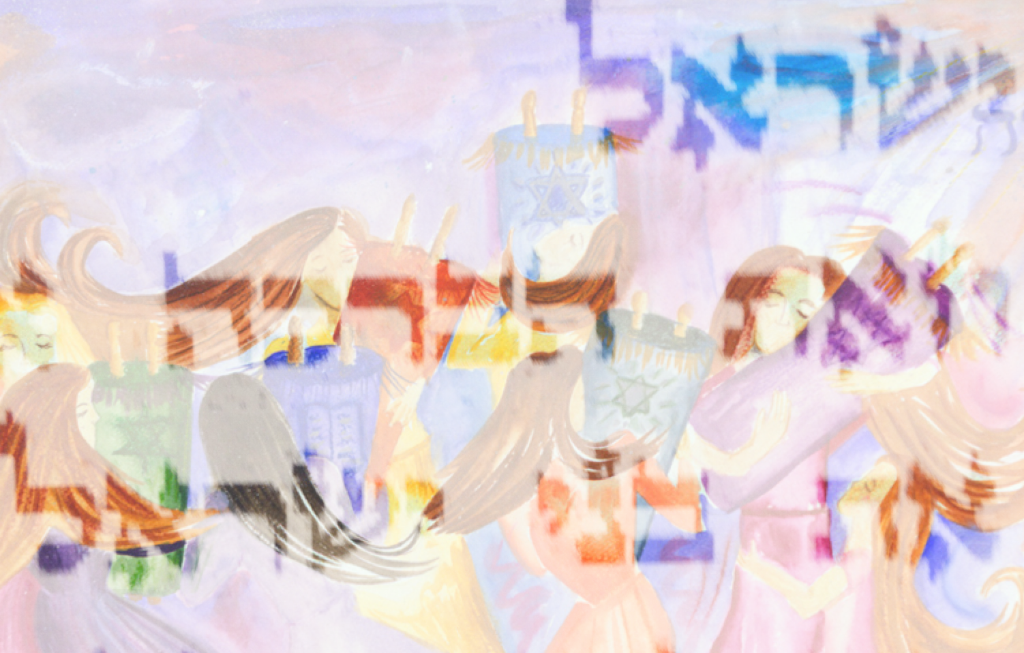
dancing, religion, ritual, sefer torah, Torah, women

simchat torah.png

Simchat Torah.

Will you step forward to dance with the Torah?

Will you remain content watching from the side-lines?  

Will you self-consciously say  ‘thank you I’m ok’ when invited you  to join the dance circle or hold the Torah?

The Torah reading for Simchat Torah begins with Vezot ha-Bracha followed by Bereshit.

Rabbi Yehudah Aryeh Leib of Gur (1847–1905) notes that the letterbet of Bereshit symbolizes Bracha, blessing, and so the Torah begins with blessing and concludes with blessing in Vezoht ha- Bracha, pointing to its essence: blessing.

God bestows the blessing as the ‘noten hatorah’ and the Jewish people in turn are a vessel to hold the blessing. This is what happens on Simchat Torah.

On a personal level, by putting our arms around the Torah, we turn ourselves into a container that holds it, both physically and spiritually.  

On a communal level, as we join hands to form a dance circle, we unite create a larger container of love around the Torah.

In this way we turn the mystical words of The Zohar into reality:

Kudsha Beri-hu, veOrayta veYisrael chad

The Holy One, the Torah and the People of Israel are one.

Simchat Torah is an urgent invitation to enact this unity.

Will you take your rightful place?


Playing on Purity

31 Sunday Jan 2016

Posted by dinabrawer in Media, Uncategorized

≈ Leave a comment

Tags

anorexia, BBC, body, body & soul, body-image, chastity, clean-living, faith, Orthodox Judaism, purity, religion, ritual, Torah, women

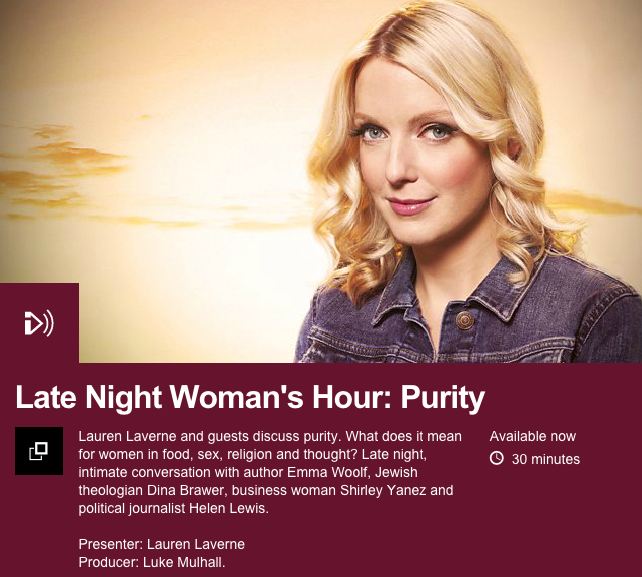
Last Wednesday night, instead of tuning into one of my long-distance classes at Yeshivat Maharat, I joined BBC Radio DJ and host Lauren Laverne for Late Night Woman’s Hour.

In a relaxed round table format we discussed what ‘purity’ means for women in the context of food, sex, religion and thought.  Emma Woolf, who chronicled her experience of anorexia in her book ‘An Apple a Day’ spoke about the current obsession for purity in food, Shirley Yanez explained why she took a vow of chastity after a near death experience, and pundit Helen Lewis addressed the subject in the context of political ideas.

My contribution – the religious perspective on purity – was substantially shaped by a recent series of ‘Pastoral Torah’ classes at Yeshivat Maharat that focused on embodied spirituality. Click on the image below to listen to the program:

Screen Shot 2016-01-31 at 14.41.40


Subscribe

  • Entries (RSS)
  • Comments (RSS)

Archives

  • March 2026
  • April 2021
  • October 2020
  • September 2020
  • May 2020
  • April 2020
  • October 2019
  • August 2019
  • February 2019
  • January 2019
  • December 2018
  • October 2017
  • September 2017
  • May 2017
  • April 2017
  • December 2016
  • October 2016
  • April 2016
  • January 2016
  • December 2015
  • October 2015
  • September 2015
  • February 2015
  • January 2015
  • December 2014

Categories

  • Important Moments
  • Jewish Festival
  • Media
  • Uncategorized

Meta

  • Create account
  • Log in

Blog at WordPress.com.

  • Subscribe Subscribed
    • dinabrawer
    • Already have a WordPress.com account? Log in now.
    • dinabrawer
    • Subscribe Subscribed
    • Sign up
    • Log in
    • Report this content
    • View site in Reader
    • Manage subscriptions
    • Collapse this bar
 

Loading Comments...